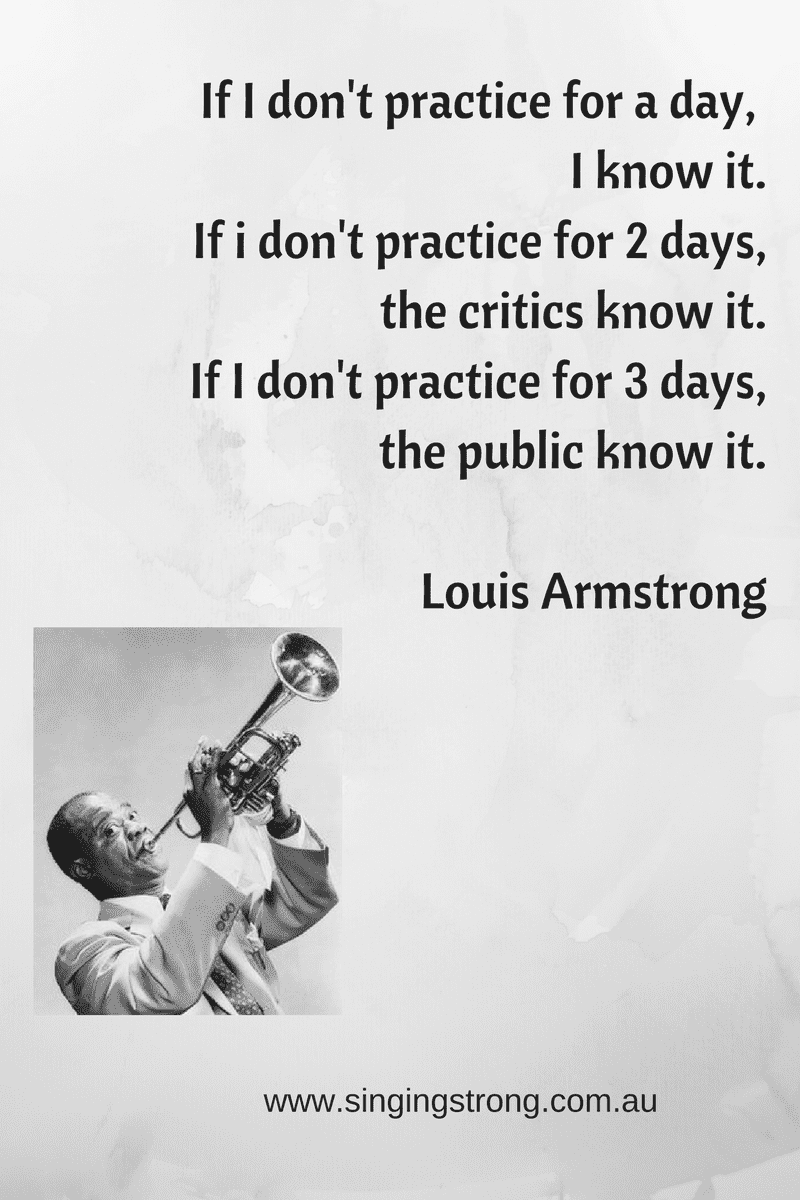
Practice

Want to Become a Better Singer? There’s No Shortcut—You Have to Practise!

The 10-minute habit that can make a real difference to your singing

You have your singing lesson. You learn something new. You leave feeling inspired and excited about your voice.

Then life happens.

School. Work. Family. Dinner. Netflix. Social media. Appointments. And suddenly it’s the day before your next singing lesson and you realise…

“I haven’t practised!”

Sound familiar?

If you want to improve your singing, there is one thing that makes a bigger difference than almost anything else:

Regular practice.

There are no magic exercises, secret techniques or shortcuts that can replace actually using your voice.

Your singing teacher can give you the tools, exercises and techniques you need—but practice is what teaches your voice to use them naturally.

And here’s the really good news:

You don’t need to practise for hours every day.

In fact, 10–15 minutes of focused practice, done regularly, can be far more effective than one long practice session every couple of weeks.

So how can you make practising easier—and actually stick to it?

Here are three simple tips.


1. Make Singing Practice Part of Your Routine

One of the biggest reasons people don’t practise is that they are waiting for the perfect time.

The problem is that the perfect time rarely appears!

Instead of thinking, “I’ll practise when I have time,” choose a regular time when you can fit singing into your day.

Perhaps it’s:

  • Before school or work
  • When you get home
  • Before dinner
  • After your morning coffee
  • Before you go to bed

It doesn’t have to be a long session.

Even 10 minutes counts.

The secret is to make singing practice a habit rather than something you have to constantly remind yourself to do.

Think about brushing your teeth. You don’t usually ask yourself, “Do I feel motivated to brush my teeth today?”

You just do it because it’s part of your routine.

Try to make your singing practice the same.

Small + regular = progress

Ten minutes of practice five times a week gives you 50 minutes of focused singing practice.

That’s much better than practising for an hour once every few weeks.


2. Practise What You Need to Improve

There’s a big difference between singing and practising singing.

Singing your favourite song from beginning to end can be fun—and absolutely has its place.

But if you want to improve, your practice needs to be more targeted.

Think about what your singing teacher has asked you to work on.

Perhaps you’re working on:

🎤 Pitch – singing the notes accurately

🌬️ Breath control – managing your breath through longer phrases

🎶 Higher notes – developing strength and confidence in your upper range

🗣️ Diction – making your words clear

😌 Relaxation – releasing unnecessary tension in your jaw, tongue or throat

💪 Vocal strength – developing a stronger, more consistent sound

Rather than simply singing the entire song again and again, spend some time working specifically on the areas that need improvement.

If one particular phrase is difficult, stop and work on that phrase.

Sing it slowly.

Break it into smaller sections.

Repeat it.

Then put it back into the song.

This is how your voice learns.

Don’t practise what you already know you can do!

It’s tempting to spend your whole practice session singing the parts of a song that feel good.

But improvement happens when you spend some time working on the things that are challenging.

Practise the problem—not just the performance.


3. Keep Your Practice Sessions Short and Achievable

Have you ever thought:

“I don’t have an hour to practise, so I won’t bother.”

Forget that idea!

You don’t need an hour.

Try a 10-minute singing practice session instead.

Your 10-minute Singing Strong practice plan

2 minutes – Warm up

Start gently and get your voice moving.

3 minutes – Vocal exercises

Work through the exercises your singing teacher has given you.

5 minutes – Song practice

Choose one section of your song and focus on improving something specific.

That’s it!

If you have more time, fantastic—keep going.

But if you only have ten minutes, you’ve still made progress.

And remember:

Quality beats quantity.

Ten minutes of really focused practice is much more valuable than 30 minutes of singing while you’re distracted, tired or simply going through the motions.

Put your phone aside.

Concentrate.

Listen to your voice.

And give yourself a specific goal for each practice session.


Why Does Regular Singing Practice Work?

Your voice is an instrument—but it’s an instrument that lives inside your body.

Singing involves your breathing muscles, vocal folds, tongue, jaw, posture, hearing and coordination all working together.

Your body needs time and repetition to learn these movements.

That’s why something that feels difficult today can suddenly feel much easier after you’ve worked on it regularly.

You may not notice the improvement from one practice session to the next.

But over weeks and months, those small improvements start to add up.

A difficult note becomes easier.

Your breathing becomes more natural.

Your pitch becomes more reliable.

Your voice becomes stronger.

You become more confident.

And eventually, something that once required a lot of concentration starts to happen almost automatically.

That’s the power of regular practice.


Don’t Wait Until You Feel Motivated

Perhaps the most important thing to remember is this:

You don’t have to feel like practising to practise.

Some days you’ll be excited to sing.

Other days you’ll be tired and would rather do anything else!

That’s normal.

The goal isn’t to have a perfect practice routine.

The goal is simply to keep coming back to it.

Even on the days when you don’t feel particularly motivated, ten minutes can make a difference.

And often, once you start singing, you’ll find that you actually want to keep going.


Your Singing Challenge

Why not try this for the next two weeks?

Practise for just 10 minutes a day.

Choose one thing to work on.

Set a timer.

Put your phone away.

Focus.

And don’t worry about being perfect.

At the end of the two weeks, ask yourself:

Does this feel easier than it did two weeks ago?

You might be surprised at the difference.


Ready to Take Your Singing to the Next Level?

At Singing Strong, singing lessons aren’t just about learning songs. They’re about helping you understand your voice, develop good technique and build the confidence to become the singer you want to be.

Your teacher can show you what you need to work on.

But your regular practice is what turns those lessons into real progress.

So don’t wait for the perfect time.

Start with 10 minutes. Start today.

 

Spot the problem

Don’t spend all your practice singing through your whole song.

Instead, find the three trickiest spots and practise just those sections.

Try this:

  • Sing the difficult phrase slowly.
  • Repeat it three times correctly.
  • Then put it back into the song.

Professional performers spend more time fixing little sections than singing the whole piece over and over.

Every small improvement builds confidence.


What to sing?

5 terrific tips for 2017

From the movie “Sing”


Hi there!  Only a couple more days to 2017.

Eeeek! I cannot believe how fast this last month has flown and we are almost at the beginning of a new year.

I hope you have all had an absolutely fabulous 2016 and are excited about 2017. I have been doing a lot of thinking recently and am trying to get planned for next year.  I am notorious for just floating along and when I have a great idea I just do it. However this can be a very dangerous way to live as there is always a great rush to get it done, I’m not planned and I often don’t do things as well as I would like. Being prepared and organized helps things to flow better and a lot more can be achieved.

So my first terrific tip is:

1. Plan ahead.

Start thinking ahead now. What would you like to achieve vocally in 2017?  Analyze what it is (make sure you are specific) that you would like to improve/achieve next year.  Write it down, plan it out.  Do you need to work on your breathing?  Would you like to extend your vocal range? By how much? When? What will you need to do to fulfill your dream?

2. Organize a practice time you can stick to every day.

Part of the reason we don’t have the success we would like is that we fail to practice.  There is no getting around this, if you want to succeed you have to put in the work.  Work out a time that you able to set aside each day to work on your skills. Then stick to it.

For some more tips and ideas on better singing practice, click on the link below.

click here for tips on singing practice


3.  Have singing lessons.

This is important thing to do.  There are many articles and videos on line about how to sing better, but none of these offer something very important. That is feedback. It is vital to have a mentor that can work with you to analyze and then work with you to improve your singing voice.  I know when working with students that I am constantly asking questions and guiding them to hear what a good voice should sound like, tweaking and adjusting constantly. If you don’t have any feedback, how do you know if what you are doing is correct? To have lessons one on one with Mary at Singing Strong  click here to register.


4. Listen to lots of music

Make sure you are always listening to good music.  Think about the artists you like and listen to them.  LOTS! There are plenty of ways to listen to music.  You tube, Pandora and spotify are just a couple of examples of places you can listen to your favourite music.  Take some time to analyze what your artists are doing that makes them a good singer.

This is my favourite song at the moment and a song I definitely want to learn.

Think about what styles of music you like and then:

5. Choose repertoire

Decide the songs you would like to learn in 2017.  Think carefully about the style of music and level of difficulty.  Aim to find at least 5 songs you could work on. Plan out the year as to which month each song will be learned by.  Remember it takes time for the body to get used to how you sing a song.  I always say allow 6 months for a song to feel right.


Do these 5 things and you are well on your way to singing success in 2017.


Want to get 2017 off to a great start?

Singing Strong is offering a Summer Singing Intensive from Monday 9th January to Friday 13th January 2017.

Five days one on one with Mary for an hour each day.  You can do this with Mary in her Traralgon Studio or on line.

There are only a few places left.

Mary Mirtschin

Work on vocal technique, performance skills as well as learn a song in 5 days!

To book click here.


Why have a singing teacher?

I have been visiting various singing websites lately and have found many of them to have great ideas and ways to help singers.

One thing I have noticed on a couple of the websites is their claim that you don’t need to have face to face lessons to sing well, just watch my videos and you can become the greatest singer.  For me this is a one way street.

My comment to this is if you don’t know what you are doing wrong, you can never know what you are doing right.

Feedback is integral to good progress.  Feedback is the rocket fuel that propels the acquisition of knowledge and without it, no amount of practice or watching videos is going to get you there.

A singing teacher is not merely there to offer encouragement and assessing levels of concentration, they are also on the lookout for small technical glitches that may have escaped the attention of their student.

You can get the basics from reading material or watching videos, but I would highly recommend you seek out a singing teacher or at least a mentor who can give you appropriate feedback and guide you on your musical journey.

teaching singing

Can anyone sing?

boy singing with mic cartoonThe answer is yes.  If you are able to talk then it is possible to sing.

Singing is a skill that can be taught just like any other instrument or any skill actually.

I have worked with many students who wanted to sing but didn’t have the skills. Over time with study and practice these students became very good singers.  These students wanted to be good singers and they put in the time and effort required to get good at it.

I am an ok dancer. I can move in time to the beat and when I take time to go over a dance routine I can learn it reasonably well.  But I will never be a great dancer.  That is because I like dancing, but not enough to want to do it all the time and take the classes to become really good at it.  My daughter loves dancing, goes to classes, practices a lot at home and is becoming really good.

But I love to sing.  I have had lots of lessons and performed quite a lot and I have developed skills I need to be a good singer.

I will never be great at violin because I don’t have an interest in playing it. I would like to learn cello though.

I love to teach but I would be pretty useless as a nurse as it is something I don’t want to do.

They say it takes around 10,000 hours to become an expert at something.  I think that this is pretty close.  If you were to ask anyone who is an expert at something, they would probably tell you these sorts of hours.  They would be working on their craft every day over a long period of time.

Learning how to sing well is like any instrument.  You can’t expect to become a concert pianist with a weeks worth of practice.

When you look at the lives of some of the famous singers who are really good at their craft –  you would discover that most have been singing since they were young children. They sing all day every day, listening to music and singing along, they probably go to voice lessons and are involved in any performance opportunity they can.

If you would like to be able to sing reasonably well, in tune, yes you can learn.  You probably don’t need to spend 10,000 hours.  Maybe 100 hours would be a great start.

How good you get depends on how much you want it. How much is your desire?  Are you willing to do what it takes to get really good?


Here is a video of  Jessie J at 15. You can tell she has been working on her craft for many years already.

Another video of a young Jessie J

A more recent live acoustic performance.


Dream!

Happy New Year 2016

Happy New Year to everyone!

I hope you all had a wonderful time of celebration at Christmas and New Year. For me it was a wonderful time with family and a chance to wind down a little after a very busy year.  As we begin 2016 there are thoughts about new year resolutions and goals set for the coming year.  I am sure that many of us have finished up with voice classes for the year and have not sung a note since the last Christmas carol at Christmas Eve.  That’s almost two weeks ago!

Just like an athlete, as soon as we stop using our voice we start to lose condition.  Singing is an every day activity if we want to be at our best. If you haven’t sung since Christmas, I suggest you get back into practice asap.  Otherwise all the technique, strength and condition will begin to be lost.

I am offering a one week Summer Singing Intensive next week,  Monday 11th Jan through to Friday 15th Jan.  This is an opportunity to focus on getting your voice back into shape. With daily hour sessions, your voice will get the workout it needs to get back into shape.

Sessions are available one on one either in person or on line.
Please note that sessions are booked at the same time each day for the five days.

Normally this sort of tuition would cost $350 but I am offering this once off opportunity for $250. That’s $100 discount.

If you would like to take advantage of this special offer  CLICK HERE to book your time.

12096281_941238815943258_454555536956770829_n